
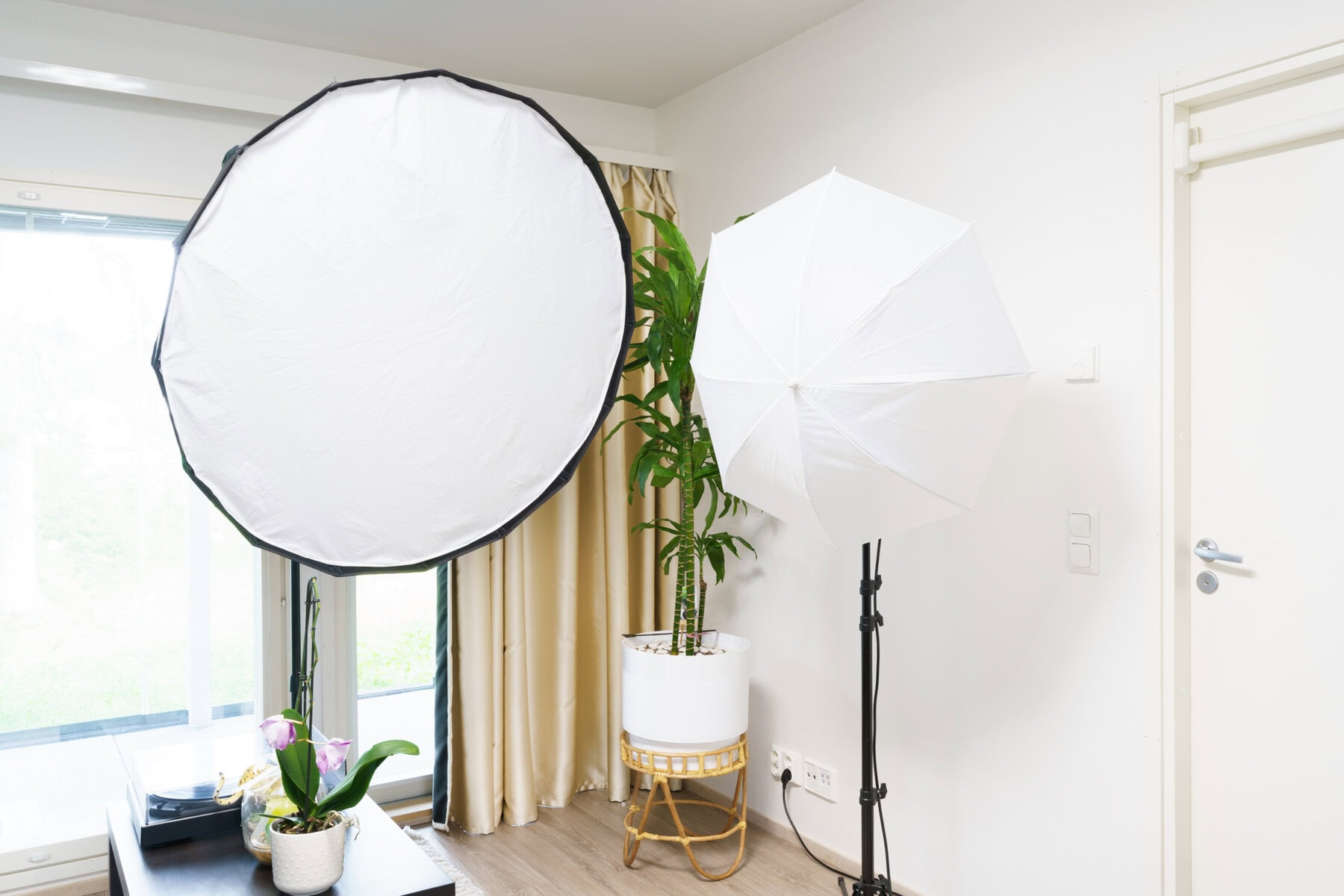
Let’s start with all the equipment that professional architectural and accommodation photography requires.
- Camera
- Tripod
- Lenses (wide-angle and standard focal length)
- Tripod head
- Phone or tablet (for remote control)
- Powerful flash or multiple flash lights
- Light modifiers (for flashes)
- Drone (insurance, registration, and completed training courses)
- Gray card
- Large white reflector for flash
- Basic filters (for protecting the front of the lens from dust)
- Cleaning supplies
- Extra batteries for all devices
- At least two memory cards (for internal camera backup)
- Camera bags
- Tripod bag
- Powerful computer
- Image editing monitor (with calibration capability)
- Pole for facade photos (rig or rod) or tilt-shift lens
As the blog progresses, I will explain how each of these accessories is used
Camera
Professionals nowadays prefer mirrorless full-frame cameras. Cameras with smaller sensors don’t fully utilize the dynamic range benefits—that is, distinguishing between dark and bright areas—as well as the advantages of high-quality lenses. This is because smaller sensors don’t cover full-frame lenses, which are generally designed to higher standards than lenses made for smaller sensors.
The camera must also be reliable and work well in different conditions. It should have good battery life to avoid frequent battery changes. Using a battery grip is also common, which doubles the battery capacity.
Additionally, the camera must support shooting uncompressed RAW files. This allows post-processing without any loss of photo quality.
Tripod
Tripods come in aluminum, carbon fiber, and wood. Of these materials, wood is the most stable because it absorbs micro-vibrations very well. Micro-vibrations can reduce image sharpness. However, wood is also the heaviest material.
Often, carbon fiber is the best compromise between stability and weight. Carbon fiber doesn’t significantly expand or contract with temperature changes, meaning thermal expansion is minimal.
Aluminum is the most sensitive to temperature changes among these materials. It is also neither very light nor very stiff, making it more susceptible to micro-vibrations.
When choosing a tripod, ergonomics play a crucial role. It must be easy to use and, most importantly, sturdy enough to prevent any camera shake. Often, multiple shots are taken—first with natural light, then several more with flash. In these cases, the camera must not move at all between shots.
A high-quality tripod ensures that the images come out sharp without needing software correction afterward, preserving the quality.
Also, when using long exposure times—sometimes up to around 20 seconds for natural light— even the slightest micro-vibration can affect the sharpness of the photos.
Lenses
Lenses play a significant role in accommodation photography. You always need a wide-angle lens to effectively capture the spaces. However, you can’t just choose any wide-angle lens. Distortion is often very noticeable in wide-angle lenses.
A high-quality lens that isn’t too wide will produce an image that, after lens corrections in Lightroom, looks flawless to the eye. Straight lines in the image must remain straight—fisheye lenses are not suitable.
Color reproduction is also important, but not the most critical factor, since colors are usually corrected by using flash lighting during the shoot. When a photo is taken professionally with flash, color inaccuracies are greatly reduced.
The lens should also deliver sharp images from edge to edge. When choosing a lens, it’s also wise to consider whether you can attach screw-on filters to it.
Additionally, you will need one or more lenses for detail shots. For example, a 50mm focal length lens is a good choice, and reasonably priced options are available for various cameras.
More expensive lenses can deliver more accurate colors, higher contrast, and a smoother bokeh effect.
Remote control
The camera shouldn’t be touched between different exposures or shots taken with flash and natural light. The images will be combined later in post-processing, so they need to be taken from exactly the same position.
At this stage, a phone or tablet with a high-quality display is needed to remotely control the camera settings. This prevents any camera shake that would occur if you adjusted the settings directly on the camera.
There are different solutions and software options for this. The best option is a dedicated Wi-Fi transmitter. Alternatively, you can use the camera manufacturer’s app and the camera’s built-in Wi-Fi. However, these apps can sometimes be less user-friendly and less reliable than a separate transmitter.
Wi-Fi transmitters can be quite expensive, often costing several hundred euros, whereas the camera’s own software is usually free.
Flash light
If you want accurate color reproduction and the ability to subtly use flash lighting in darker areas of your photos, a high-quality flash is an essential tool. The flash must have a remote trigger feature, allowing you to control it either directly on the flash unit or via a separate controller.
Preferably, it should not be controlled via a transmitter mounted on the camera, as this can cause the camera to move.
The flash or flashes must be powerful enough to light large spaces effectively. Additionally, the flash should have excellent color rendering quality. The cheapest models can cause color issues and headaches during post-processing.
Light modifiers
Different architectural or accommodation photography subjects may require different lighting. When using flash, I aim to add a bit of sharpness, color correction, and natural additional light to the darker areas of the image. In this, light modifiers play a key role.
For example, if the place doesn’t have white walls or a white ceiling, you can’t reflect the flash light off these surfaces. Without proper reflection, colors may not appear natural.
In such cases, various light diffusers or white, foldable reflectors are used. For wooden surfaces, a smaller softbox or diffuser on the flash works well to soften the light.
Drone
Purchasing a drone depends on its intended use and current regulations. The safest choice is to select a drone weighing under 250 grams, as this allows for a wider range of uses.
You also need to obtain insurance for the drone, which is readily available nowadays. The drone must be registered, and a registration fee must be paid.
For operation, everyone is required to complete an online test at minimum. In addition to the online test, it’s recommended to take an in-person written exam. This exam is usually mandatory only for operators of larger drones, but it’s a great way to ensure your skills even when using smaller drones.
It’s also advisable to get propeller guards and multiple spare batteries for the drone. If you’re shooting multiple locations in one day, you might not have time to recharge batteries between flights.
There is a website where drone use must be reported, and you can also see no-fly zones there. Modern drones typically alert you if you’re in a restricted area and won’t take off until you move out of the no-fly zone.
Gray card
A gray card is a neutral gray shade that can be placed in a photo taken of the subject. It is used as a reference for color temperature and shifts in purple and green tones.
It’s best to photograph the gray card in several different parts of the same scene because reflections from various surfaces can affect color calibration.
Calibration is generally used when the subject lacks white surfaces. This is because white surfaces can also provide a fairly accurate white balance manually, in addition to manual adjustments.
Filters
One of the most important filters in accommodation photography is the ND filter and the circular polarizer filter. A circular polarizer can adjust the direction of light. By modifying the light’s direction, reflections from various surfaces—such as glass or strong light reflected off floors—can be eliminated.
I also use a regular UV filter (a clear protective glass) in front of this filter during transport. This helps control dust effectively since dust particles can otherwise settle on the front of the lens during transit.
Before shooting, the filters are removed, and compressed air is used to blow dust off the lens surface to ensure a clean front lens. Immediately after, a lens hood is attached, which prevents dust settling from the room’s air.
While a small amount of dust might seem minor, dust on the front lens can be very visible in photos and may require extensive post-processing.
Cleaning supplies
A crucial part of producing high-quality photos is keeping your equipment clean. The most important areas to maintain are the front of the lens, filters, the rear lens element, and the camera sensor.
For cleaning, use high-quality, preferably disposable microfiber cloths to avoid transferring dirt back onto surfaces. The cleaning solution should also be of excellent quality to prevent residues from remaining on the surfaces.
For sensor cleaning, there are specialized kits available, but most of the time, a gentle blow of air using a manual air blower designed for camera cleaning is sufficient. This method is gentle enough not to damage any camera parts and is usually made of plastic, so it won’t cause major damage if it accidentally touches the camera.
There are also dust-filtered versions of small air blowers that reduce the risk of dust transfer.
I strongly advise against using harsh chemicals or low-quality cleaning products, as these can damage expensive coatings found on lenses and other optical elements.
Spare batteries
Batteries are a crucial part of photography. Cheaper cameras usually come with smaller batteries, whereas higher-end models often have batteries that can last through multiple shoots on a single charge.
Still, it’s good to have several spare batteries, especially for drones, which consume the most power among your equipment.
Having charging docks for all your batteries is also beneficial, as it allows you to charge multiple batteries at once.
Memory cards
Different situations may call for different memory cards. I personally prefer reputable, high-quality brands, as they best guarantee speed and data reliability.
For accommodation photography, you might not need the absolute fastest card for camera use, but faster cards can speed up transferring photos to your computer.
I recommend having at least three cards, preferably of the same capacity. I usually keep one large card in the camera and another slightly smaller one as a backup. This way, if I haven’t cleared the backup card recently, there’s still plenty of space, and I don’t have to erase it on-site through the camera.
For video recording, I use a faster card, which also serves as a backup card for photography. If one card fails, I still have backups of future shots simply by swapping cards.
Camera bags
This is more a matter of personal preference. I personally like camera bags—or a combination of bags—that also offer weather protection when needed. They should be well-padded to protect the camera, lenses, and other gear.
It’s important to choose a bag that fits everything you need for the shoot without being unnecessarily bulky. Simplicity saves time and hassle.
For a tripod bag, make sure it’s sized properly and offers good protection for your specific tripod. It should also be ergonomic and comfortable to carry.
Computer and monitor
I usually start by doing basic edits in Lightroom and then move to Photoshop for more detailed adjustments. Sometimes, I also use other software for precise color grading if needed.
At times, I might have dozens or even hundreds of images open simultaneously on my computer. For smooth workflow, a powerful and high-quality computer is essential. Based on my experience, the computer should have at least 64GB of RAM and a reasonably powerful processor.
A fast SSD is also important, as it speeds up various operations and saves time, enabling efficient photo editing.
While you can edit photos one by one on a basic computer, it’s not very smooth compared to batch processing many images at once—like converting all files to PSD or JPG formats.
One image might include three natural light exposures and several flash exposures if the space is large. This means a single photo could consist of multiple combined shots, requiring significant processing power and memory.
A computer monitor also can’t be just a basic display. Over time, colors on the screen shift as the monitor ages, so it needs to be calibrated regularly.
The best results come from monitors that support internal calibration—some higher-end manufacturers offer this feature.
Basic monitors also reproduce significantly fewer color shades, limiting your ability to accurately review and edit photos.
With a high-quality, calibrated monitor, you can inspect images in much greater detail and make precise adjustments as needed.
Stands and solutions
There are several options for photographing building façades.
One method is using a pole to raise the camera high enough to prevent the building from appearing distorted or “tilting.”
Alternatively, a drone can be used for aerial façade shots.
Sometimes, a combination of a ladder and a tripod is employed to achieve stability and maintain a clean shooting angle.
A commonly used tool is the tilt-shift lens, which has a built-in adjustment that corrects perspective directly in the lens, eliminating the need for extra height.
Summary
Accommodation photography can be done in many different ways. More advanced techniques require time both during shooting and in post-processing, but the results are often excellent.
That said, you don’t need the most expensive equipment to get started. Basic gear can already take you far. The tools mentioned earlier help make the work easier and smoother.
I didn’t mention any specific brands because there are many manufacturers. Choices like materials and sensor size in system cameras mostly affect workflow and are more universal considerations than brand-specific.
If you’re already familiar with a particular system, chances are that manufacturer offers a range of cameras and lenses, so there isn’t necessarily one perfect solution. Budget also plays a role—you might spend a few hundred euros or over a thousand on a tripod, for example.
In the end, the overall setup and usability matter most. But mastering the use of your tools is crucial for producing high-quality accommodation photos.
Gear is only a means. If you would rather have the finished images without the investment, see my accommodation photography service.


 EN
EN FI
FI ES
ES